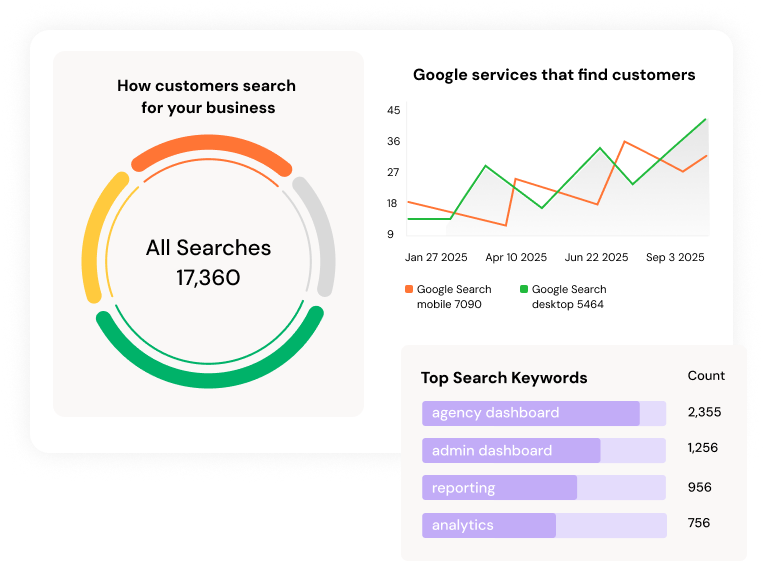
A GMB reporting tool helps businesses, agencies, and local SEO professionals understand how their Google Business Profile is performing across Google Search and Google Maps. Instead of reviewing individual metrics manually, a reporting system brings important performance information together so you can understand visibility, customer interactions, local rankings, reviews, and changes over time.
The term GMB reporting is still widely used in the local SEO industry, even though Google renamed Google My Business to Google Business Profile. Whether you call it GMB reporting, GBP reporting, or Google Business Profile reporting, the purpose is the same: turning local business data into information that can help you evaluate performance and make better optimization decisions.
This guide explains what GMB reporting is, why it matters, what a GMB reporting tool should track, how businesses can use reporting, and how agencies can create clearer reports for multiple locations and clients.
What Is GMB Reporting?
GMB reporting is the process of collecting, organizing, monitoring, and analyzing performance information associated with a Google Business Profile. The information available can vary depending on the reporting platform and connected data sources, but local SEO reporting commonly focuses on visibility, customer actions, reviews, rankings, profile activity, and other useful business metrics.
The main purpose of reporting is not simply to display numbers. A useful report should help a business understand what is happening with its local search presence and identify areas that may need attention.
For example, a business may want to know whether customers are finding its profile, whether people are visiting its website from the listing, whether phone interactions are changing, whether reviews are increasing, or whether important local keywords are moving in search results.
A well-organized reporting process brings these questions together and turns scattered performance information into a clear picture of local search activity.
What Is A GMB Reporting Tool?
A GMB reporting tool is software or a reporting platform that helps businesses and SEO professionals monitor and present Google Business Profile and local SEO data. Depending on the platform, it may provide dashboards, scheduled reports, location-level reporting, keyword tracking, review monitoring, competitor information, historical comparisons, and other local search metrics.
The biggest advantage of a reporting tool is organization. Businesses with one location can use reporting to monitor their progress, while agencies and organizations with multiple locations can use centralized reporting to manage much larger amounts of information.
Instead of manually checking different data points and preparing reports from scratch, a reporting system can make the process more consistent and easier to repeat.
Why Is GMB Reporting Important?
Creating a Google Business Profile is only the beginning of maintaining a local online presence. After a profile is created and verified, businesses need to understand how customers interact with it and whether their local SEO activities are producing useful results.
This is where GMB reporting becomes valuable. Reporting creates a historical record of performance and allows businesses to compare changes instead of relying on occasional observations.
GMB reporting can help businesses:
- Monitor Google Business Profile performance.
- Understand customer interactions with their listing.
- Track relevant local keyword rankings.
- Monitor review activity and reputation.
- Compare performance across different time periods.
- Identify changes that may require further investigation.
- Evaluate ongoing local SEO activities.
- Prepare professional reports for business owners and clients.
- Compare performance between multiple business locations.
The real value of reporting comes from understanding the information rather than simply collecting it. A useful report should answer practical business questions and help determine what deserves attention next.
🚀 Need Help With Your Google Business Profile?
If you need help creating, verifying, optimizing, or managing your Google Business Profile, our team can help. We also assist businesses with verification problems, service-area profiles, and suspended Google Business Profiles.
What Does A GMB Reporting Tool Track?
The exact metrics available in a GMB reporting tool depend on the platform and its connected data sources. However, a useful local SEO reporting system should make it easier to monitor the information that matters most to the business.
Important reporting areas can include profile performance, customer actions, local visibility, rankings, reviews, and location-level information.
Google Business Profile Performance
Profile performance information helps businesses understand how users are interacting with their Google Business Profile. Depending on the available reporting data, this may include profile views, searches, website interactions, calls, direction-related actions, or other customer activities.
Local Keyword Rankings
Local keyword tracking can show how a business performs for selected search terms in local search results. Ranking information can be useful for identifying movement over time, but it should always be interpreted in context because local search results can vary according to location, device, competition, search intent, and other factors.
Customer Actions
A local business listing is valuable because it can connect searchers with real business actions. Depending on available data, reporting may help businesses monitor actions such as website visits, phone interactions, or requests for directions.
These metrics can provide more practical information than simply knowing that a profile appeared in search.
Google Reviews And Reputation
Reviews are an important part of a local business's online presence. Reporting can help businesses monitor review activity, changes in review volume, ratings, and responses.
Monitoring reviews regularly also makes it easier to identify customer feedback that deserves a response or further attention.
Profile Information And Health
Some reporting systems also help businesses monitor profile completeness and information that may require attention. Keeping business information accurate is important because customers rely on Google Business Profile information when deciding whether and how to contact a business.
How Does A GMB Reporting Tool Work?
A typical reporting workflow starts by connecting or collecting relevant business profile and local SEO information. The system then organizes the available data into dashboards or reports that can be reviewed over a selected period.
A basic GMB reporting workflow usually looks like this:
- Connect The Business Profile: Select the appropriate business profile, location, or reporting data source.
- Select Important Metrics: Choose the performance information that matters to the business.
- Set The Reporting Period: Select a suitable period for reviewing performance, such as weekly or monthly.
- Review Performance: Examine changes in visibility, customer actions, rankings, reviews, and other available metrics.
- Compare Historical Data: Compare the current period with previous periods where reliable historical information is available.
- Identify Opportunities: Look for meaningful changes or areas that deserve additional investigation.
- Create The Report: Present the most important information in a clear format that the intended reader can understand.
What Should Be Included In A GMB Report?
A good GMB report should contain information that helps answer real business questions. It should not simply contain every metric available in the reporting platform.
| Reporting Area | What It Shows |
|---|---|
| Profile Performance | Available information about how users discover and interact with the business profile. |
| Website Actions | Available website-related actions generated through the business profile. |
| Phone Actions | Available information about customer phone interactions. |
| Direction Requests | Available location-related actions from users interested in visiting the business. |
| Local Rankings | Position changes for selected local keywords when ranking tracking is available. |
| Reviews | Review activity, rating trends, and reputation-related information. |
| Location Comparison | Performance differences between individual business locations. |
| Historical Trends | Changes in performance across selected reporting periods. |
Why Monthly GMB Reporting Matters
One of the most useful ways to use a GMB reporting tool is to create consistent monthly reports. A single day's performance rarely provides enough context to understand a local SEO campaign.
Monthly reporting creates a repeatable process for comparing performance and documenting changes. It can also help businesses understand whether changes are temporary or part of a longer-term pattern.
Monthly GMB reporting can help answer questions such as:
- Did profile activity change compared with the previous month?
- Did customer actions increase or decrease?
- Which local keywords changed position?
- Did review activity change?
- Which location generated the most customer activity?
- Which profile areas may need additional attention?
A monthly report should not be treated as a final judgment about SEO performance. It should be used as one source of information alongside business conditions, seasonal demand, marketing activity, and other relevant factors.
GMB Reporting For Local SEO
Local SEO reporting and GMB reporting work closely together because the Google Business Profile is an important part of a local business's online presence.
Local SEO involves more than a business profile. It can include website optimization, local landing pages, citations, reputation management, content, links, and other activities. Reporting helps organize performance information so businesses can evaluate their local search efforts more effectively.
If your profile needs optimization before you begin measuring performance, you can learn more about GMB Profile Optimization and how profile improvements can fit into an ongoing local SEO strategy.
How GMB Reporting Helps Businesses Make Better Decisions
The strongest reporting systems do more than display metrics. They help users understand what the numbers may mean and what information deserves further investigation.
For example, if website actions increase while overall profile visibility remains relatively stable, the business may want to investigate what changed on the profile or website. If a location's customer actions decline while other locations remain stable, that location may deserve a closer review.
Reporting should therefore be viewed as a decision-support process rather than a collection of statistics.
A useful reporting cycle is:
- Measure: Collect relevant performance information.
- Compare: Review the information against appropriate historical periods.
- Interpret: Consider what may have contributed to the changes.
- Investigate: Check the profile and surrounding local SEO factors.
- Act: Make appropriate improvements based on the findings.
- Monitor: Continue tracking performance after changes are made.
GMB Reporting For Agencies
Agencies managing Google Business Profiles for clients often need a reporting process that can scale. Preparing individual reports manually for every client can consume significant time, especially when an agency manages many locations.
A GMB reporting tool for agencies can help centralize information and create a more consistent reporting workflow.
Agencies may use reporting to present:
- Google Business Profile performance.
- Local keyword ranking changes.
- Customer actions.
- Review activity.
- Location-level performance.
- Historical comparisons.
- Optimization activity.
- Recommendations for future work.
Clear reports can also make client communication easier because clients can see what has been monitored and which areas require attention.
GMB Reporting For Multiple Locations
Businesses with multiple stores, offices, branches, or eligible service locations have more complex reporting requirements than businesses with one location.
A single overall number may hide important differences between individual locations. One branch may generate strong customer activity while another may require additional attention.
For this reason, a useful multi-location reporting system should make it possible to review individual locations as well as the overall business portfolio.
Before reporting can provide useful information, businesses should make sure their individual profiles are correctly established and managed. If you are working on profile verification, visit our GMB Profile Verification page for more information.
GMB Reporting For Service Area Businesses
Service-area businesses can have different reporting requirements from businesses that receive customers at a traditional storefront. Their local presence may cover several service areas while their actual operations are based around providing services to customers.
Reporting for a service-area business should therefore focus on the information that is relevant to its actual business model and eligible Google Business Profile setup.
Businesses that need assistance with service-area profile verification can review Service Area GMB Profile Verification for additional information.
GMB Reporting After Profile Creation And Verification
Reporting becomes most useful when it is part of an ongoing profile management process. A business may first create its profile, complete the required verification process, optimize the listing, and then monitor its performance over time.
If you are still setting up your profile, you can review GMB Profile Creation before beginning a long-term reporting workflow.
Businesses that are experiencing verification problems can also review GMB Verification to understand the verification process and available options.
What Is The Difference Between GMB Reporting And GMB Optimization?
GMB reporting and GMB optimization are connected but perform different functions.
| GMB Reporting | GMB Optimization |
|---|---|
| Measures and organizes performance information. | Improves and maintains profile information. |
| Helps identify trends and changes. | Focuses on profile improvements. |
| Can include rankings, actions, reviews, and visibility data. | Can include categories, services, business information, photos, and other profile elements. |
| Helps communicate performance. | Helps maintain the quality and relevance of the profile. |
In practice, the two processes work together. Optimization creates changes that can later be monitored, while reporting provides information that can help identify areas worth reviewing.
Can GMB Reporting Improve Google Rankings?
A reporting tool does not directly improve Google rankings simply by generating reports. Its value comes from helping businesses understand performance and identify areas that may need attention.
For example, reporting may show that certain locations are performing differently or that particular local keywords have changed position. The business can then investigate its profile, website, competition, reviews, local relevance, and other factors before deciding what action is appropriate.
This distinction is important because reporting measures performance; it does not replace SEO work.
How To Read A GMB Report
Reading a GMB report correctly requires looking at trends and relationships instead of focusing on one isolated number.
When reviewing a report, consider the following:
- Time Period: What period does the data represent?
- Previous Performance: How does it compare with an appropriate previous period?
- Location: Is the information for one location or multiple locations?
- Business Changes: Were profile updates or marketing changes made during the period?
- Seasonality: Could seasonal demand explain part of the change?
- Customer Actions: Are users taking meaningful actions after finding the profile?
- Ranking Context: Are ranking changes being evaluated across appropriate keywords and locations?
This approach reduces the risk of treating one metric as the complete picture of local SEO performance.
Common GMB Reporting Mistakes
Reporting can lose its value when businesses focus on quantity instead of usefulness. A report containing dozens of metrics is not necessarily better than a report containing a smaller number of carefully selected metrics.
Using Too Many Metrics
Including every available metric can make a report difficult for clients and business owners to understand. Reports should focus on information that connects with the actual goals of the business.
Ignoring Historical Context
A number has limited meaning without context. Comparing suitable periods can make changes easier to interpret and can help distinguish normal fluctuations from patterns that deserve further investigation.
Focusing Only On Rankings
Rankings are useful for understanding local search visibility, but they should not be treated as the only measure of success. Customer actions, website activity, calls, reviews, and business outcomes can provide additional context.
Creating Reports Without Recommendations
A report becomes more useful when it explains what should be reviewed next. Recommendations should be based on the available data and the actual circumstances of the business rather than generic SEO statements.
Ignoring Profile Accuracy
Reporting cannot replace accurate profile management. Businesses should continue checking important information such as business details, hours, services, and other relevant profile elements.
How Often Should You Use A GMB Reporting Tool?
The ideal reporting frequency depends on the business, number of locations, level of SEO activity, and reporting goals.
Monthly reporting is often practical for ongoing local SEO because it provides enough time to identify meaningful changes while creating a consistent record of performance.
Businesses managing large location portfolios may also benefit from more frequent monitoring for operational changes, reviews, profile issues, or important performance events.
The important point is consistency. A reporting process should use a predictable schedule so performance can be compared over time.
How To Choose The Right GMB Reporting Tool
Not every business needs the same reporting platform. The right GMB reporting tool depends on the number of locations, reporting goals, required metrics, team size, and whether reports are intended for internal use or clients.
Before choosing a reporting solution, consider:
- Data Sources: Understand where the platform gets its reporting information.
- Metrics: Make sure the tool provides the information you actually need.
- Location Support: Check whether it can manage your number of business locations.
- Keyword Tracking: Determine whether local ranking data is available if you need it.
- Review Monitoring: Check whether reputation-related reporting is included.
- Historical Data: Look for useful comparison options if long-term analysis is important.
- Automated Reports: Agencies may benefit from scheduled client reports.
- Dashboard: Information should be easy to understand and navigate.
- Export Options: Consider whether reports can be exported in the format your team or clients need.
GMB Reporting For Clients
Client reporting requires a different approach from internal SEO analysis. A business owner may not need every technical detail available to an SEO professional.
A client-friendly GMB report should focus on the information that matters to the business and explain important changes in simple language.
A strong client report can follow this structure:
- Performance Summary: Explain the most important changes.
- Key Metrics: Present relevant customer and profile activity.
- Ranking Overview: Show important local keyword movement where applicable.
- Reputation: Summarize relevant review activity.
- Work Completed: Explain important profile or SEO activities.
- Next Steps: Identify the areas that should receive attention during the next period.
GMB Reporting For Multiple Business Profiles
Managing multiple Google Business Profiles creates a larger reporting challenge because each location can have different customers, competitors, search behavior, and performance patterns.
A centralized reporting process makes it easier to compare locations without losing the details of individual branches.
For example, a business with twenty locations may want to know which branches are generating strong customer actions, which locations are experiencing ranking changes, and which profiles have review or information issues.
Location-level reporting makes these differences easier to identify and gives the business a clearer basis for deciding where additional attention may be required.
How GMB Reporting Supports Reputation Management
Online reputation is an important part of local business management. Customers can use Google reviews to evaluate a business before contacting or visiting it.
A reporting process can help businesses maintain visibility into review activity by monitoring new reviews, rating changes, response activity, and other available reputation information.
The goal is not simply to increase the number of reviews. Businesses should focus on providing good customer experiences and responding professionally to genuine customer feedback.
GMB Reporting And Competitor Analysis
Competitor information can provide additional context when evaluating local search performance. A change in rankings does not necessarily mean that the business changed something; competitors may also have changed their profiles, reviews, content, or local SEO activities.
When competitor tracking is available, businesses can compare relevant local signals and investigate why competitors may be gaining or losing visibility.
Competitor analysis should be used as context rather than as a reason to copy another business's profile. Each business should maintain accurate information that reflects its own services and operations.
GMB Reporting For New Business Profiles
New business profiles can benefit from establishing a reporting baseline. Early performance may change as customers begin discovering the listing, reviews accumulate, and the business establishes its local presence.
Recording performance consistently from the beginning makes it easier to compare future results with the initial baseline.
If you have not created the profile yet, visit GMB Profile Creation to learn more about setting up a Google Business Profile before beginning your long-term reporting process.
What Happens If A Google Business Profile Is Suspended?
A suspended Google Business Profile presents a different problem from ordinary performance reporting. A reporting tool should not be treated as a suspension recovery solution.
When a profile is suspended, the business should first determine the appropriate resolution process and make sure the profile complies with Google's requirements.
If you are dealing with a suspended listing, you can review our Suspended Google Business Profile Service for assistance with profile suspension issues.
Once the profile is active and properly managed, ongoing reporting can help monitor its performance over time.
GMB Reporting Checklist
Use the following checklist when creating or reviewing a GMB reporting process:
- Confirm the correct Google Business Profile is being tracked.
- Verify that important business information is accurate.
- Select metrics that match the business objectives.
- Track relevant customer actions.
- Monitor local keyword rankings when appropriate.
- Review Google Business Profile activity.
- Monitor review and reputation activity.
- Compare performance with suitable previous periods.
- Review individual locations separately when managing multiple profiles.
- Investigate significant changes before drawing conclusions.
- Document important profile changes.
- Turn useful findings into practical next steps.
Best Practices For Effective GMB Reporting
The quality of a report depends on how the data is selected, organized, and interpreted. Businesses should build reporting around their actual goals instead of creating a generic collection of numbers.
- Keep Reports Consistent: Use a predictable reporting format and schedule.
- Focus On Relevant Metrics: Avoid unnecessary information that does not help decision-making.
- Use Comparisons: Compare appropriate periods whenever reliable historical data is available.
- Explain Important Changes: Give context instead of presenting unexplained increases or decreases.
- Separate Locations: Analyze individual branches when a business manages multiple profiles.
- Connect Reporting With Optimization: Use findings to identify areas that deserve review.
- Keep The Reader In Mind: A client report should be understandable without unnecessary technical language.
GMB Reporting Features To Look For
| Feature | Why It Matters |
|---|---|
| Performance Dashboard | Provides a central place to review important Google Business Profile and local SEO information. |
| Multi-Location Reporting | Helps businesses and agencies evaluate individual locations as well as overall performance. |
| Keyword Tracking | Helps monitor selected local search terms and ranking changes when ranking data is available. |
| Review Monitoring | Helps businesses keep track of review activity and reputation-related information. |
| Historical Comparisons | Makes it easier to identify trends and changes across reporting periods. |
| Automated Reports | Can reduce repetitive manual reporting work for agencies and multi-location businesses. |
| Export Options | Allows teams to use reporting information in their preferred workflow or client reporting process. |
Why GMB Reporting Should Focus On Business Outcomes
The purpose of local SEO is not simply to increase a number inside a dashboard. Businesses ultimately care about being discovered by relevant customers and generating meaningful actions.
For this reason, GMB reporting should connect visibility metrics with customer behavior whenever reliable information is available.
A report becomes more useful when it helps answer questions such as whether customers are finding the business, whether they are visiting the website, whether they are contacting the business, whether they are requesting directions, and whether the profile is attracting relevant local attention.
This approach prevents reporting from becoming a vanity-metric exercise and keeps the focus on information that can support real business decisions.
Frequently Asked Questions About GMB Reporting
1. What is GMB reporting?
GMB reporting is the process of monitoring and presenting performance information related to a Google Business Profile. Depending on the available data, reporting can include profile activity, customer actions, reviews, local rankings, visibility, and other local SEO metrics.
2. What is a GMB reporting tool?
A GMB reporting tool is a software platform or reporting solution that helps businesses and SEO professionals collect, organize, analyze, and present Google Business Profile and local SEO performance information.
3. Why do businesses need GMB reporting?
GMB reporting helps businesses understand how their Google Business Profile is performing over time. It provides a structured way to review changes, customer activity, local visibility, reviews, and other relevant information.
4. Can a GMB reporting tool track Google Maps performance?
Reporting capabilities vary by platform and data source. Some tools provide Google Maps or local visibility information, while others focus on specific Google Business Profile metrics. Businesses should review the exact data provided by each reporting platform.
5. Can agencies use a GMB reporting tool?
Yes. Agencies can use reporting tools to organize performance information for multiple clients and locations. Features such as scheduled reports, dashboards, location management, and historical comparisons can be useful for agency workflows.
6. How often should GMB reports be created?
Reporting frequency depends on the business and its goals. Monthly reporting is often practical for ongoing local SEO because it provides a consistent period for comparing performance and reviewing meaningful changes.
7. Does GMB reporting improve rankings automatically?
No. A reporting tool does not automatically improve Google rankings. Reporting provides information that businesses and SEO professionals can use to understand performance and decide which areas may need further optimization.
8. What metrics should a GMB report include?
Relevant metrics can include profile activity, customer actions, website interactions, phone actions, direction requests, reviews, local keyword rankings, and location-level performance. The exact metrics should be selected according to the business's goals and available data.
9. Can GMB reporting be used for multiple locations?
Yes. Multi-location businesses can use reporting to monitor individual profiles and compare performance across locations. This can help identify branches that require additional attention.
10. Is GMB the same as Google Business Profile?
Google Business Profile is the current name of Google's business listing product that was previously known as Google My Business. GMB remains a common term in the local SEO industry, which is why phrases such as GMB reporting and GMB reporting tool are still widely used.
11. Can GMB reporting track Google reviews?
Some reporting platforms provide review monitoring or reputation reporting features. The exact information available depends on the platform and connected data sources.
12. Can a GMB reporting tool track local keyword rankings?
Some local SEO reporting tools provide keyword rank tracking. Local ranking data should be interpreted carefully because rankings can vary according to search location, device, competition, and other factors.
13. What is the difference between GMB reporting and GMB optimization?
GMB reporting focuses on measuring and presenting performance information, while GMB optimization focuses on improving and maintaining the business profile. Both can work together as part of an ongoing local SEO strategy.
14. Can GMB reporting identify profile problems?
Reporting can highlight changes or unusual performance patterns that may deserve investigation. However, a performance change alone does not necessarily identify the exact cause of a problem. The profile and relevant business circumstances should be reviewed before taking action.
15. Should a GMB report include recommendations?
Recommendations can make reports more useful when they are based on relevant data and the actual goals of the business. Instead of providing generic suggestions, recommendations should explain which areas deserve attention and why.
Conclusion
A GMB reporting tool gives businesses and local SEO professionals a structured way to understand Google Business Profile performance. Instead of looking at isolated numbers, businesses can monitor relevant metrics, compare historical performance, review customer actions, monitor local rankings, evaluate review activity, and identify areas that may require additional attention.
Effective GMB reporting is not about putting the largest possible number of metrics into a dashboard. The goal is to provide the right information in a format that helps people understand what is happening and what should be investigated next.
For agencies, reporting can make client communication and multi-location management more organized. For local businesses, it can provide a clearer view of their Google presence and help them monitor changes over time.
When reporting is combined with accurate profile creation, proper verification, ongoing optimization, reputation management, and consistent local SEO work, it becomes a practical part of managing a stronger Google Business Profile presence.
.png)
.png)
.png)
.png)
.png)
.png)
.png)
.png)